AI brings content volume, but ruins authenticity. Here’s how to fix it.
Social media feeds have rapidly changed, and continue to do so. Essentially, most feeds deliver a higher volume of posts, with clear structure. Most posts also start to look like each other. All have a short opening line. All start with a question. All use short sentences. Dashes and misplaced capitals. And somehow, despite that growing volume of content, they become less worth reading.
The B2B space is no exception. Most B2B SaaS startups understand that AI brings extreme value to their content creation process. What used to take hours now takes minutes. What used to take 4 content marketers can now be done by one. AI brings efficiency, and that is useful. But if you look more closely, somewhere along the way, speed became the goal and content quality quietly took a back seat.
And here we are… the number of posts has exploded, social feeds scroll down to infinity. More content, but less differentiation and value.
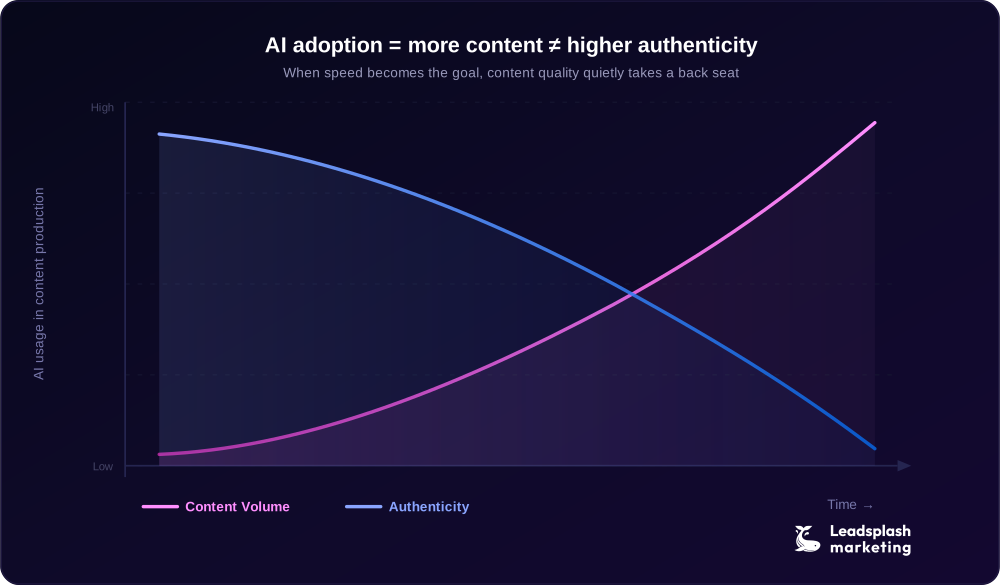
The real problem isn’t AI. It’s how people use it.
The reason content becomes mediocre is that content creators treat AI as a typewriter. They prompt it, get a near-finished piece back, make a few tweaks, and hit publish. The issue with that approach is structural. AI pulls from what already exists. It recombines patterns and language that are already widely used. The output reads well. It looks polished. But it rarely says anything you haven’t heard before.
Content that comes out of this process is:
Structured, but not distinctive
Polished, but not insightful
Consistent, but not memorable
Differentiation doesn’t come from phrasing or format. High-quality content comes from perspective, shared knowledge, experiences, and best practices. It’s sharing something that actually challenges, informs, or resonates with the people you’re writing for. That’s exactly the layer that disappears when AI writes your final piece, using simplified prompting.
The shift: stop using AI to write. Start using it to think.
Don’t use AI as a content engine, but as a tool to reflect, pressure-test, and refine. Ask AI to make your story stronger, more comprehensive, and more valuable. Ask AI to challenge your ideas, thoughts, and opinions, not to facilitate it. Let AI help you distinguish your content from the rest, not create more of the same.
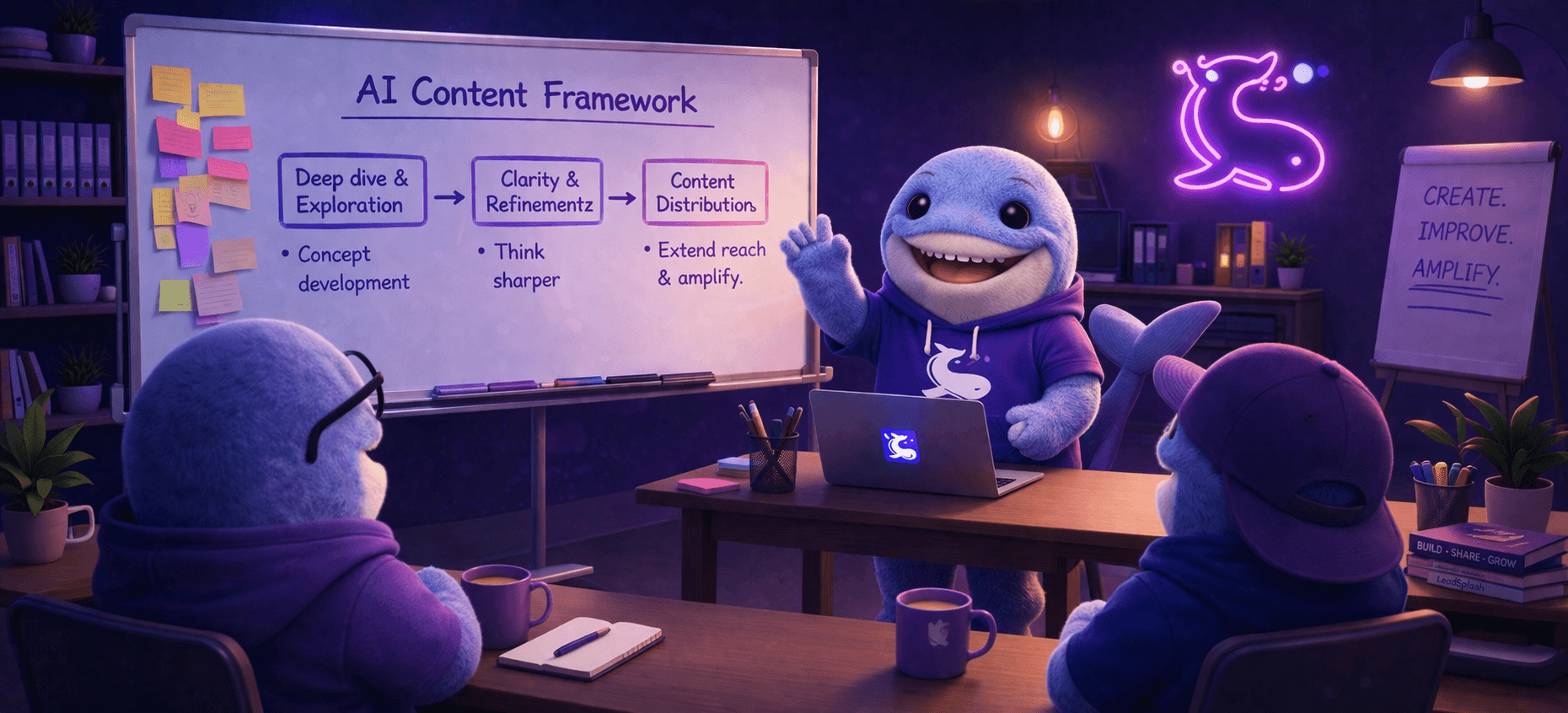
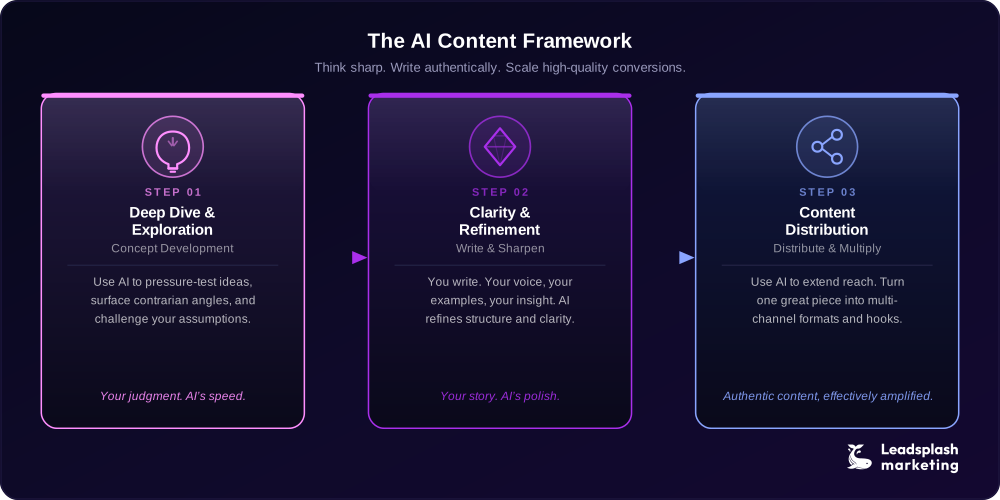
We've identified three simple steps to create high-value content, without compromising on authenticity and impact.
1. Use AI for concept development
This is where AI adds the most value, and where not many people actually use it. Before you write anything, use AI to pressure-test your thinking. Ask it to surface contrarian angles. Have it challenge your assumptions. Use it to get to the core of what you actually want to say and why it matters to your audience. Right prompting is key. Let's take this example:
Instead of:
“Write me a LinkedIn post about AI in content marketing”
Try:
“What’s a non-obvious angle on AI in marketing that most people aren’t talking about?”
This is where differentiation starts. The judgment of what’s worth saying is still yours. But AI can help you get there faster, with more depth and refinement.
2. Write it yourself — then use AI to sharpen it.
Once the concept is clear, the writing should come from you. Your experience, your expertise, your opinions. That’s what makes content credible, insightful, educational and...worth reading.
You write it, but AI can still help in the process:
Restructuring sections that feel off
Improving clarity and tightening phrasing
Provide different perspectives and context
Catching spelling and grammar issues
But don't let AI kill your unique, magic touch: your original thinking, your examples, your tone of voice. Those are the things that make people come to you or your business. Of course you can train your own LLM and make it write in your very own, unique way. Excellent. This allows you to challenge yourself (and your well-trained LLM-friend) to stretch the boundaries of excellent content and impact.
3. Use AI to scale distribution, not production.
Most adoption of AI is in the prompting, logically resulting in content production and effiency. But the most overlooked step, and probably the biggest missed opportunity, is the impact of AI in the distribution of your message.
Once you have created your content masterpiece, AI can become a multiplier. You should use it to:
Turn one blog into multiple LinkedIn post variations
Extract short-form insights for different channels
Adapt messaging for specific audiences or communities
Test different hooks and openings
This is where velocity adds real value. You’re not creating more from scratch, you’re extending your success effectively.
A quick example
Let's illustrate how these three simple steps can help to create content fast, while keep (or even strengthen) your authenticity.
Imagine a startup wants to write about AI in marketing.
The typical approach: prompt AI to write a post, publish with light edits. Result: well-structured, completely generic. Low engagement.
Now compare:
Step 1 — Concept
Use AI to find a sharper angle, and to refine it.
Something like: “AI is making content more scalable, but less distinctive.”
Step 2 — Creation
Build on that with real observations. Competitors publishing similar content. Engagement dropping. Nobody saying anything new.
Step 3 — Distribution
Use AI to extend the reach. AI-generated post variations, native format and language adaptations, in-depth snippets, analysed or validated quantifications, and so much more.
Same topic, incomparable outcomes.
Summary
AI isn’t the reason content quality is declining, it’s just exposing how content is currently being made. With the rapid rise of AI, many B2B SaaS startups and content marketers are using AI to take their benefits. But the people who stand out won’t be the ones producing the most. They are those who're using AI to think sharper, define a clearer perspective, and scale what truly resonates. That’s where content starts to differentiate, and to convert.
If you want to scale your authentic brand faster, we can help. Leadsplash marketing offers stage-based programs and fractional CMO leadership to bring strategy and direction, tactics, best practices and most importantly, outcomes. Don't hesitate reaching out to us, book your free consultation, we would love to hear from you.